The video starts with a locked door. It’s a simple beginning for a revelation that has shaken Minnesota to its core. Independent journalist Nick Shirley didn’t need subpoenas or secret sources. He just needed a car, a camera, and a simple, devastating question: “Where are the children?”
His journey through the streets of the Twin Cities, visiting state-funded daycare centers, uncovered a chilling reality. Buildings that received millions in taxpayer subsidies for caring for dozens of children stood silent, empty, and often seemingly abandoned. At the “Quality Learning Center,” a misspelled sign hung over a darkened building licensed for 99 kids. It pulled in $1.9 million in 2025 alone. The “Future Leaders Early Learning Center,” approved for 90 children and having collected $6.67 million over two years, was a complete ghost town. Shirley’s knocking echoed in vacant hallways.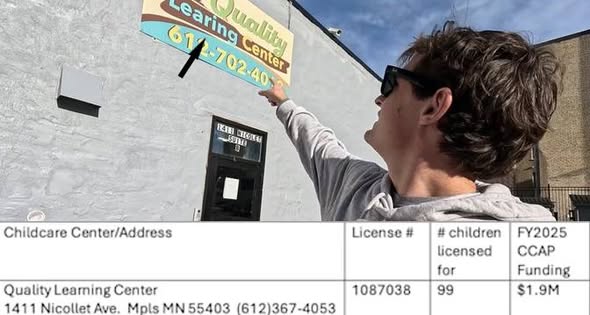

“The scale is just staggering,” Shirley can be heard saying in the viral video, as he moves from one suspicious site to the next. At Mako + Mini Child Care, licensed for 120 children across two licenses, he found no evidence of little ones. ABC Learning Center, funded with $3 million over three years, appeared completely inactive. In every case, when rare staff were present, they offered flustered, unconvincing answers or outright refused to explain where the children they were being paid to care for actually were.
The plot thickens far beyond daycare. Shirley points his lens at a single, nondescript building that houses a maze of 22 separate healthcare or autism service entities registered to the same address. This pattern, repeated across locations, points away from simple mismanagement and toward a sophisticated, coordinated operation. The centers and services appear to trace back to a network of the same individuals, suggesting a systemic scheme to funnel public money into phantom services.
In just one day of filming, Shirley connected over $110 million in state childcare subsidy payments to these hollow addresses. The video, a damning visual audit, has become a cultural lightning rod, amassing over 40 million views and climbing. It has forced a conversation that oversight agencies seemingly missed, asking how such vast sums could flow for years with so little apparent verification of actual service.
The public reaction has been a firestorm of outrage and demand for accountability. Tech billionaire Elon Musk amplified the fury, calling for the prosecution of Minnesota Governor Tim Walz, framing the scandal as a catastrophic failure of stewardship. While the call for a specific prosecution is politically charged, it underscores the intense pressure now on every level of Minnesota government to act. The question on every taxpayer’s mind is blunt: were state officials incompetent, or complicit?
For now, all eyes are on Minnesota’s next move. The quiet neighborhoods that host these “ghost” centers have become the unlikely stage for a showdown over transparency, fraud, and the social contract. Nick Shirley’s camera has done its job, exposing a silence that speaks volumes about broken systems. The empty classrooms are no longer just empty; they are an accusation. And Minnesota must answer.